


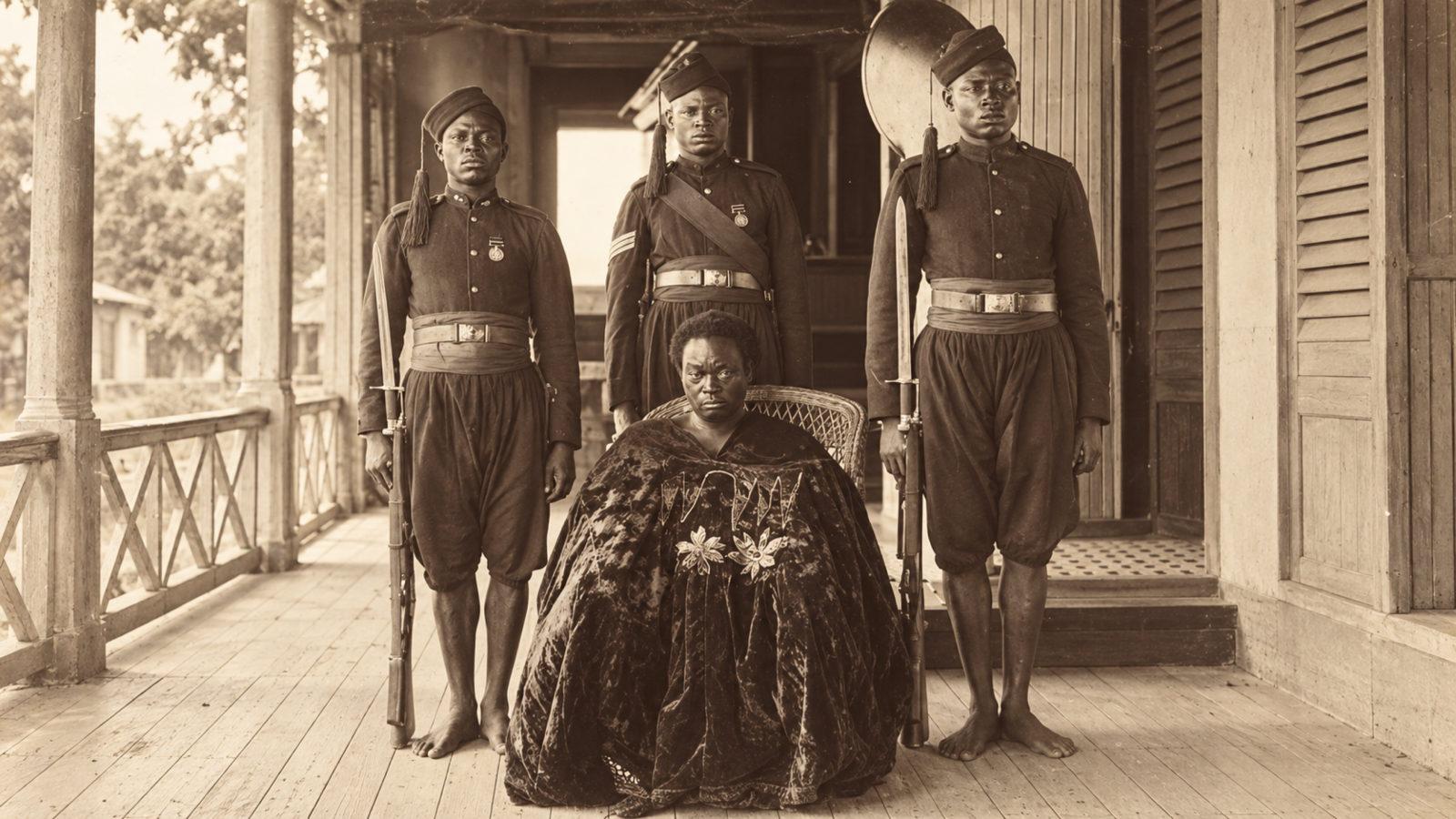
In February 1897, British forces burned Benin City, deposed its king and shipped thousands of royal treasures to Europe. The reason Britain gave was revenge.
Weeks earlier, on 4 January, a British column of roughly 250 men had been ambushed near Ughoton, the Benin river port that British records call Gwato. Seven of the nine British officials were killed, along with many of the African carriers travelling with them, whose deaths were never counted.
What is disputed is whether the ambush caused the war or simply provided the occasion for one. The answer lies in five years of tension over trade and sovereignty, a treaty the two sides read differently, and one letter written before anyone died.
Who was Oba Ovonramwen?
He was born Idugbowa around 1857, a son of Oba Adolo, and came to the throne in 1888 or 1889. He ruled as Ovonramwen n’Ogbaisi, usually translated as “the rising sun that spreads over all”. British officials wrote him into their files as Overami.
The Oba of Benin was the kingdom’s religious head and controlled its most valuable exports. He was not an absolute ruler. The Uzama, the hereditary nobles who crowned him, held their own authority, as did the palace societies and town chiefs. Ovonramwen’s early reign involved putting down chiefs who had backed rival candidates, some of whom were executed. The Nigerian historian Philip Igbafe, whose study of Benin under colonial rule remains the standard work, describes a young king consolidating power inside a court built to check him.
The royal monopoly on palm oil and ivory paid for that court. Any deal that opened Benin to outside traders cut straight into the revenue that made him king.
What was the Kingdom of Benin?
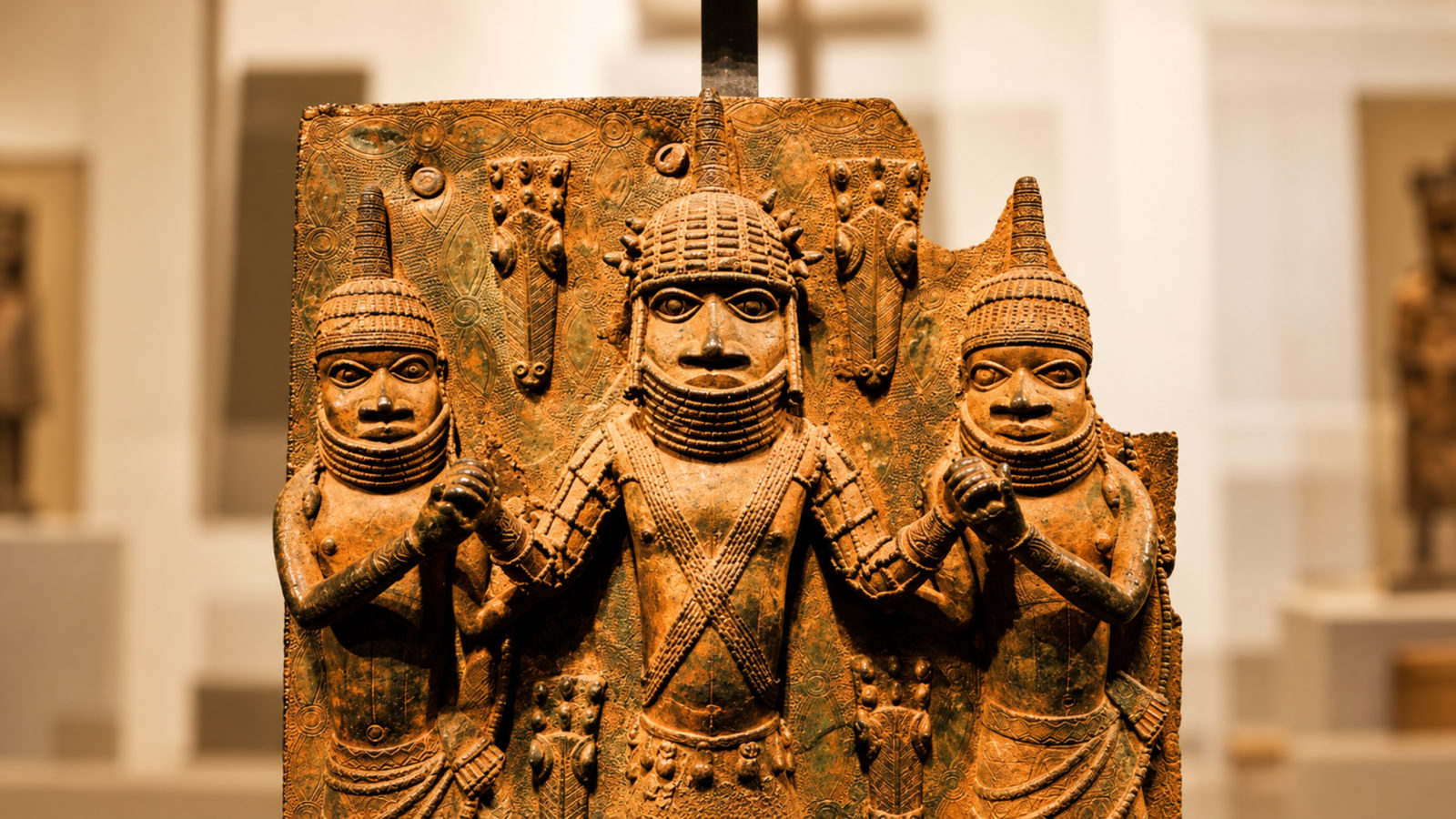
Benin was one of the oldest states in West Africa’s forest zone, ruled from a walled capital its people called Edo. Its craft guilds worked under royal patronage, and its brass casters produced the plaques and commemorative heads now known worldwide as the Benin Bronzes. European traders had been calling at Ughoton for about four hundred years. The kingdom has no connection to the modern Republic of Benin.
Two facts complicate any simple story. Benin sold captives to European traders for centuries, and ritual executions were carried out at the palace, a practice the historian Robin Law argues in a 1985 study in African Affairs intensified in the nineteenth century as outside pressure grew.
None of this made Benin unusual among states of its time, and none of it justified 1897. It does mean the kingdom was neither the innocent society of some modern retellings nor the “city of blood” of British propaganda.
Why did Britain want Benin?
By the 1890s the Niger Delta was among the most commercially valuable coastlines Britain controlled. Palm oil greased industrial machinery and fed the soap and candle trade. Rubber prices were rising, and Benin’s forests held both. Ivory moved along the same creeks.
In 1891 Henry Gallwey became British vice-consul for the Benin River district. He wanted traders to reach producers directly, without paying middlemen. Ovonramwen’s royal monopoly was the largest obstacle in his way.
Britain was also racing rivals. France and Germany were active in the region, and after the Berlin Conference of 1884 to 1885 European powers had agreed that claims on the African coast needed effective occupation to be recognised.
Britain’s commercial interest is well documented. Historians still argue over how much it weighed against imperial strategy, the ambitions of officials on the spot, and a sincere belief among some that they were ending atrocities.
The 1892 treaty: a deal or a misunderstanding?
In March 1892 Gallwey travelled to Benin City and presented a treaty, which Ovonramwen agreed to.
In the British reading, Benin had accepted British protection, given up dealings with other foreign powers and opened its territory to free trade. From then on, officials treated every Benin trade restriction as a breach of a binding agreement.
In practice, Benin carried on as before. The royal monopoly and trade dues stayed. Benin accounts also stress that Ovonramwen did not touch the pen himself.
The historians A. F. C. Ryder and Philip Igbafe both question how much of the treaty’s meaning was conveyed. No Edo-language version exists, the document followed the standard form Britain used for protectorate treaties along the coast, and ideas such as “protection” and “sovereignty” had no direct Edo equivalents.
The consequence mattered more than the ceremony. After 1892, any dispute could be filed in London as a treaty violation rather than a disagreement between two states, which made later military action look lawful from the British side.
The letter, the warning and the ambush
In late 1896, with Consul-General Ralph Moor on leave, Acting Consul-General James Robert Phillips was running the Niger Coast Protectorate.
In November he wrote to the Foreign Office asking permission to depose the Oba by force. He argued that Benin’s trade restrictions were strangling the district, and suggested the cost of the operation could be covered by ivory held in the palace. He set out for Benin before any reply arrived.
He had asked for an audience. The Oba replied that he was in the middle of the Igue ceremonies, during which custom forbade him from receiving strangers, and asked Phillips to wait. Itsekiri intermediaries, whom British records call Jakri, warned the party to turn back. Phillips kept going.
On 4 January 1897 the column was ambushed at Ugbine, near Ughoton. Only two British officers survived: Alan Boisragon and Ralph Locke.
Did Ovonramwen order it? British officials at the time said so. But testimony taken at trials the British themselves ran after the conquest points the other way: the Oba had ordered that the party be left alone, and senior chiefs overruled him. The attack was led by the war chief Ologbosere, who evaded capture until 1899 and was then hanged. Britain deposed the Oba regardless. What he knew, and when, remains uncertain.
So why did Britain attack?
No single cause explains it. Several pushed in the same direction.
Britain was turning informal influence into formal rule across West Africa, and Benin was one of the last independent states left. Trade in palm oil, rubber and ivory runs through the consular correspondence. Benin’s independence collided with the authority Britain claimed under the 1892 treaty. The Phillips killings supplied the public justification, and reports of ritual killing shaped how the war was sold at home.
How to weigh those factors is still contested. In The Brutish Museums, the Oxford archaeologist Dan Hicks argues that the expedition was long planned and that the humanitarian framing was propaganda. Staffan Lundén, writing in the International Journal of Cultural Property, argues that Hicks pushes several claims further than the documents support, and Hicks has replied that no substantive error was identified.
What the record does carry is this: the intention to remove Ovonramwen predates the ambush, because Phillips proposed it himself in November 1896. And the killings at Ugbine were real, carried out by Benin chiefs acting on their own judgement. Both are true at once.
Nine days in February: the Benin Expedition of 1897
Rear Admiral Harry Rawson led a force of roughly 1,200 men inland in three columns, armed with Maxim guns, rockets and light artillery, alongside African Protectorate troops and thousands of carriers. Benin’s defenders fought with older firearms and prepared ambush positions.
The advance began on 9 February. Benin City fell on 18 February 1897. Fire spread through the city while British troops were present, and the palace burned. Before it did, it was emptied.
British losses were recorded by name. Benin’s dead were never counted. No count was attempted, which is why modern estimates range from the hundreds into the thousands.
What happened to Oba Ovonramwen?
Ovonramwen left the city before it fell and stayed out of British hands for six months. He surrendered in August 1897. After he failed to attend a meeting with Ralph Moor on 9 September, he was arrested, formally deposed and sent into exile in Calabar aboard the Protectorate yacht Ivy.
He never saw Benin again. He died in Calabar in January 1914.
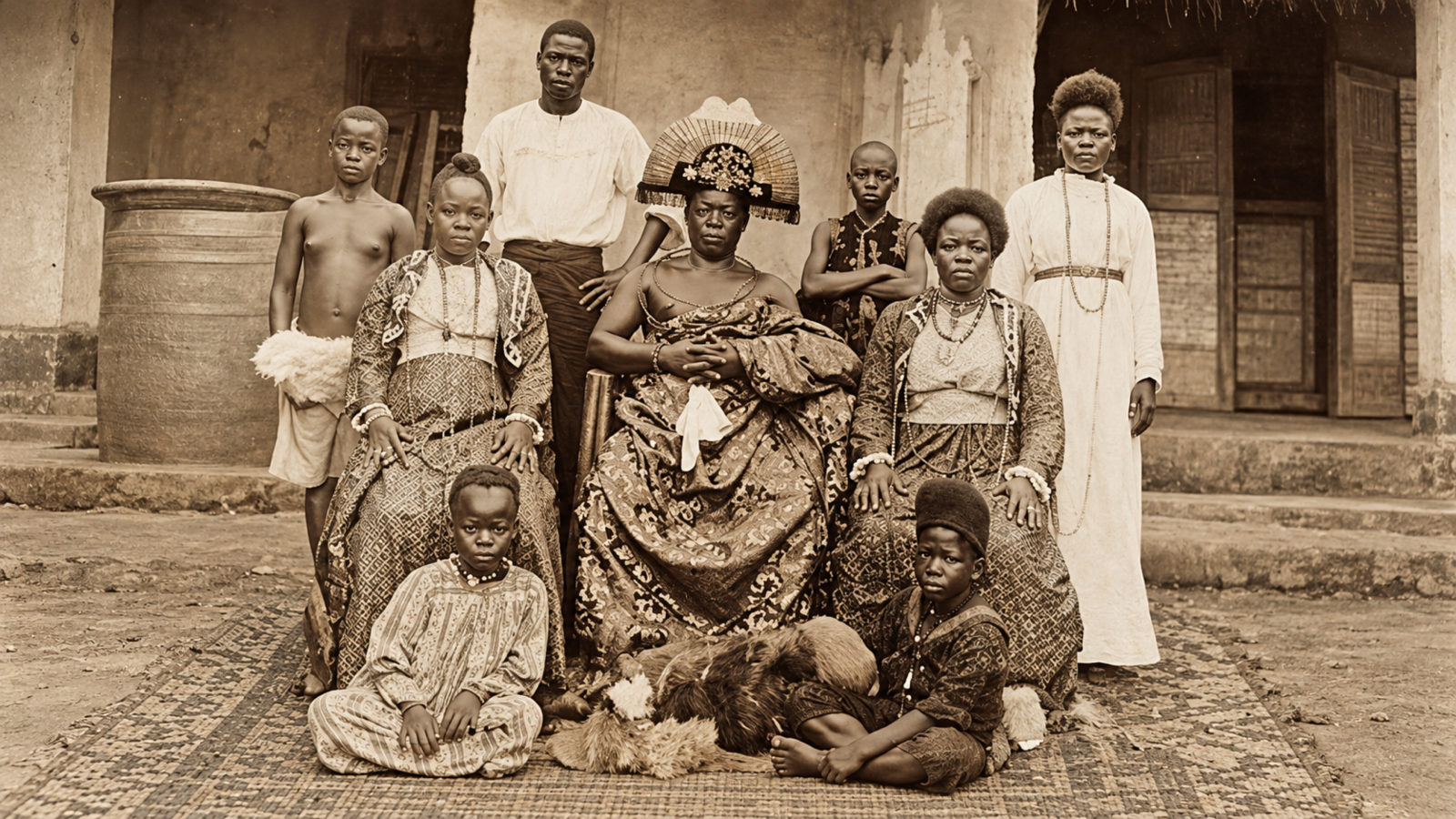
The throne stood empty for seventeen years. After his death, his eldest son, Aiguobasimwin, became Oba Eweka II. The office, the palace and the ceremonies returned. Independence did not: Benin had been absorbed into what became colonial Nigeria.
What happened to the Benin Bronzes?
The “Benin Bronzes” are thousands of objects in brass, bronze, ivory and wood made by royal guilds over several centuries. They were not decoration. The plaques on the palace pillars recorded reigns, battles and court hierarchy, and commemorative heads of past Obas stood on ancestral altars. In a kingdom that kept no written records, they were the state archive.
After 1897 they scattered. Some went to the British Museum through the Foreign Office, others were auctioned partly to cover the expedition’s costs, and officers kept pieces their families sold over the following century.
The Digital Benin project, based at the MARKK museum in Hamburg, has traced 5,246 of them across 131 institutions in 20 countries. The British Museum cares for more than 900, the largest collection anywhere.
Since 2022, returns have accelerated. Germany agreed to transfer ownership of more than a thousand objects. The Horniman Museum in London transferred ownership of 72. The Netherlands returned 119 at a ceremony in Lagos in June 2025, and three Swiss museums handed over 18 objects in June 2026. The same year, the University of Cambridge transferred ownership of 116, around a hundred of which are to be sent home.
Nigerian institutions and the Benin royal court argue the objects were taken in a conquest and belong with the court that commissioned them. Holding museums cite conservation and public access, and the British Museum says the British Museum Act 1963 bars it from permanently giving away its collection.
Inside Nigeria, a further question emerged over who should receive returned objects. A 2023 presidential declaration recognised the Oba of Benin as their owner, and the National Commission for Museums and Monuments now manages returned material on his behalf.
Why 1897 still matters
First, because the objects are still moving. Every restitution agreement signed since 2022 rests on an account of how they were taken in 1897. The historical record is doing live legal and diplomatic work.
Second, because of who wrote that record. Most of what Britain published about Benin in 1897, including Commander Reginald Bacon’s Benin: The City of Blood and Boisragon’s The Benin Massacre, was written by men who took part in the expedition while it still needed public defence. Historians now read those accounts as evidence about their authors as much as about Benin.
Third, because the question behind it never went away: how governments build the case for war, and what survives when that case is checked. When Britain examined its own reasons for invading Iraq, the 2016 Chilcot Inquiry found that intelligence had been presented with unjustified certainty. The situations are not equivalent, but the lesson carries: a justification can be sincerely held and commercially convenient at the same time. The officials writing about Benin in 1896 appear to have believed what they wrote. They also wanted the palm oil and the ivory, and said so in the same correspondence.
The verdict the evidence allows
The fall of Ovonramwen cannot be explained by the ambush at Ugbine alone.
By January 1897, Benin and Britain had been in dispute for five years over trade, territory and a treaty neither side read the same way. A British official had already asked to remove the king and proposed how to pay for it. When Benin chiefs attacked a British column against their king’s instruction, they handed London the occasion for a war it had already considered.
What followed was a nine-day campaign, a burned capital, a king’s death in exile, and a kingdom’s history scattered across four continents.
More than a century later, the question is no longer just how Benin fell. It is who wrote the story, who kept the evidence, and who decides where that evidence belongs.



Comments
No comments yet. Be the first to share your thoughts.